
- North Star Consulting Group
- 24 Oct 2026
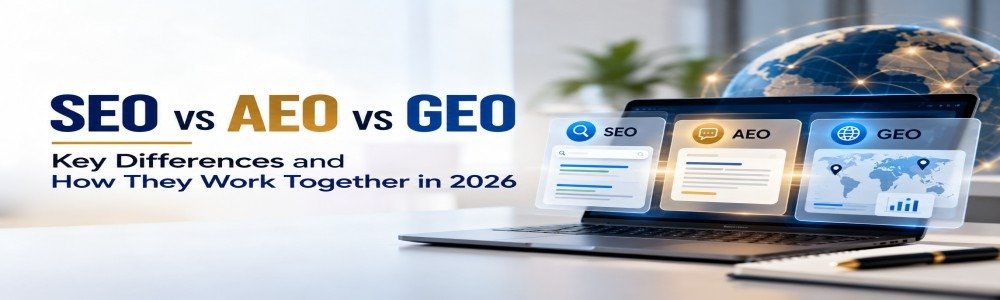
SEO vs AEO vs GEO: Key Differences and How They Work Together in 2026
SEO (Search Engine Optimization) helps websites improve their visibility in organic search results. AEO (Answer Engine Optimization) focuses on making content easy to find and use in direct answers, while GEO (Generative Engine Optimization) aims to improve a brand's visibility in AI-generated responses. Businesses can use all three approaches together to improve online discoverability, provide useful information, and reach potential customers.
What Is SEO?
SEO is the process of improving a website’s visibility in organic search results through technical improvements, quality content, keyword research, proper website structure, and credible backlinks.
The goal is to help search engines understand a website’s content and connect relevant pages with users searching for related information.
What Are the Key Components of SEO?
- Technical SEO: Ensures that search engines can crawl, render, and index important website pages correctly.
- On-page SEO: Improving page titles, headings, content, internal links, and meta descriptions to help search engines understand the page.
- Content strategy: Creating and publishing useful, accurate information that meets the needs and expectations of the target audience.
- Off-page SEO: Building website authority and reputation through relevant editorial backlinks, brand mentions, and other credible references.
- Performance analysis: Tracking organic impressions, clicks, search rankings, and conversions to measure results.
What Is AEO?
Answer Engine Optimization (AEO) focuses on making information easy for answer-based systems to find, understand, and deliver to users.
These experiences include featured snippets, voice search responses, and direct answers provided by search platforms.
Focus on providing clear, accurate, and concise answers.
What Are the Key Components of AEO?
- Use question-based headings that match what users are searching for.
- Start relevant sections with short, direct answers.
- Organize content with clear headings, bullet points, and comparison tables.
- Include relevant facts, clear definitions, and practical examples.
- Use structured data that accurately represents the page content.
- Ensure important website pages provide clear and consistent information.
What Is GEO?
Generative Engine Optimization (GEO) aims to increase the likelihood of a business, its content, or its expertise being referenced in AI-generated responses.
These experiences include AI-powered search engines and conversational tools that combine information from multiple sources.
GEO focuses on building a clear brand identity, sharing reliable information, creating useful and original content, and maintaining a strong online reputation.
Key components of GEO
- Publish original research, practical insights, and verifiable facts.
- Maintain a consistent business identity across your website and trusted external profiles.
- Support important claims with reliable sources.
- Create detailed content that answers related questions and meets users’ needs.
- Earn editorial mentions and backlinks from trustworthy, relevant websites.
- Keep business descriptions, service details, and other important information accurate and consistent across all platforms.
SEO vs AEO vs GEO: What Are the Main Differences?
SEO, AEO, and GEO overlap, but each focuses on a different aspect of search visibility.
| Factor | SEO | AEO | GEO |
|---|---|---|---|
| Primary objective | Improve organic search visibility | Make information suitable for direct answers. | Improve visibility in generative AI responses. |
| Main focus | Rankings, relevance, and technical accessibility | Clear, direct, and extractable answers | Credibility, context, and source selection |
| Typical discovery experience | Organic search results | Featured snippets and answer-oriented results | AI-generated summaries and recommendations |
| Content approach | Relevant, comprehensive, and useful pages | Question-led content with clear answers | Evidence-based content with useful context |
| Key measurements | Impressions, clicks, rankings, and conversions | Answer visibility and relevant search-feature appearances | AI mentions, citations, and qualified referral traffic |
| Business outcome | Organic discovery and website visits | Faster access to information and answer visibility | Brand exposure and potential consideration by AI-assisted users |
SEO improves search visibility, AEO focuses on direct answers, and GEO aims to increase visibility in AI-generated responses. These approaches complement each other rather than work separately.
How Do SEO, AEO, and GEO Work Together?
Businesses do not need separate content strategies for SEO, AEO, and GEO; one coordinated approach can support traditional search, direct answers, and AI-powered discovery.
Step 1: Build a technically accessible website.
Start with a strong SEO foundation by ensuring important pages can be crawled and indexed, fixing broken links, organizing site navigation, and making the website mobile-friendly.
Search systems must be able to access and understand information before they can show it in search results or AI-generated responses.
Step 2: Understand search intent
What questions do customers ask when they are deciding on a product or service?
For a consulting company, these questions might include:
How can businesses increase online sales through digital marketing strategies?
What are the key components of digital transformation?
How much does it cost to build an e-commerce site?
How can a company measure the return on investment (ROI) of its digital marketing campaigns?
Use keyword research, customer feedback, and search data to identify topics that meet real business needs.
Step 3: Structure content around clear answers
Create helpful pages with clear headings, simple explanations, relevant examples, and useful details.
Start with a direct answer to the main question, explain the details in the following sections, and finish with practical recommendations.
This approach improves readability and helps people and automated systems understand the content more easily.
Step 4: Demonstrate expertise and credibility
Give evidence to support significant claims; where suitable, include the original data, references to the authors, the dates of publication, comments from experts, and links to reliable sources.
Avoid unsupported statistics, vague claims, and repetitive content that offers no new value to readers.
Step 5: Strengthen brand authority
Keep your business information consistent across your website, professional profiles, and relevant industry publications.
Share useful insights on trusted websites to build credibility and earn relevant mentions, rather than focusing only on backlinks.
Step 6: Measure results and improve
Regularly review your website’s performance and update content to keep the information accurate and relevant.
Track organic visibility and conversions using search analytics, and check AI platforms to see if they mention or cite your business.
What Are the Best Practices for AI Search Optimization in 2026?
Create people-first content.
Create helpful content that meets your audience’s needs with clear explanations and practical advice, rather than focusing only on search engine rankings.
Use structured data appropriately.
Properly implemented Schema.org markup, such as Article, Organization, and BreadcrumbList, helps search engines understand page content, but it does not guarantee better rankings or inclusion in AI-generated responses.
Keep business information consistent.
Keep your business name, services, expertise, and contact details accurate and consistent so customers and search systems can clearly understand your business.
Avoid outdated AI search shortcuts.
Adding an llms.txt file, repeating keywords, publishing large amounts of AI-generated content, or adding FAQ markup does not guarantee better visibility in AI search results.
Focus on accessibility, useful content, accuracy, and credibility. Google confirms that established SEO best practices remain relevant to its AI-powered search features.
Track meaningful business outcomes.
Online visibility matters most when it supports business goals, so track leads, enquiries, sales, and assisted conversions alongside search rankings, impressions, and AI mentions.
What Common Optimization Mistakes Should Businesses Avoid?
Businesses may waste resources if they treat AEO and GEO as quick technical fixes rather than ongoing optimization strategies.
Common mistakes include:
- Neglecting SEO: Traditional SEO remains essential for improving search visibility, attracting organic traffic, and helping users discover your website.
- Generic AI-generated content may struggle to build trust if it lacks original ideas, useful information, and real value for readers.
- Ignoring technical issues can reduce visibility because search engines may struggle to access or index important pages.
- Using too many keywords can make content harder to read and does not guarantee better search rankings.
- Earn backlinks from trusted, relevant websites in your industry to improve your website’s credibility and search visibility.
- AI-generated responses can vary by platform, search query, and context.
- Measure meaningful results: Track qualified website traffic, leads, and sales to evaluate marketing performance instead of focusing solely on online visibility.
Which Optimization Strategy Should Your Business Focus On?
The right approach depends on your website’s current performance, business goals, and target audience.
1. For new websites, it is important to focus on technical SEO, ensure that the service pages are clear, and provide useful basic content.
2. Websites that have a steady flow of organic traffic should improve the quality of their content, respond to common customer questions, and enhance their conversion processes.
3. For businesses that are aiming to make use of AI-assisted discovery, it is necessary to create content based on evidence, define a clear brand identity, and keep an eye on mentions and citations of AI.
4. B2B companies should publish detailed guides, practical case studies, expert analysis, and other resources that help buyers evaluate solutions.
E-commerce businesses should optimize product descriptions, category pages, and customer information while providing a smooth and user-friendly shopping experience.
Most businesses should focus on strong SEO fundamentals while creating content that answers users’ questions and supports visibility in AI-powered search.
Frequently Asked Questions
1. What is the difference between AEO, GEO, and SEO?
SEO improves a website’s visibility in organic search results, AEO helps content appear in direct-answer experiences, and GEO focuses on increasing a brand’s visibility in AI-generated responses. Although these approaches have different goals, they complement one another as part of a broader search strategy.
2. Is SEO still important in 2026?
SEO remains essential in 2026 because technical accessibility, relevant content, user-friendly website design, and reliable information help search engines understand and rank web pages. Google also emphasizes that established SEO best practices remain important for its AI-powered search experiences.
3. Does GEO take the place of traditional SEO?
GEO should complement SEO rather than replace it. Businesses still need accessible website pages, valuable content, and a trustworthy online presence to improve their visibility across traditional search engines and AI-powered platforms.
4. What measures can a business take to improve its AEO?
Answer frequently asked questions by customers directly, use clear headings, give accurate definitions, and illustrate the explanations with relevant examples. Arrange the information in a logical order and include appropriate structured data where it is applicable.
5. What methods can businesses use to measure GEO performance?
Track your brand’s mentions and citations by testing a consistent set of relevant queries across AI platforms. Record the sources they reference and monitor qualified referral traffic and conversions where tracking is available. Repeat these checks regularly because AI-generated responses can vary over time.
6. Does structured data ensure that AI has visibility?
Structured data helps search engines understand a page’s content, but it does not guarantee higher rankings, featured snippets, or citations in AI-generated responses. Ensure that the markup accurately reflects the page content and follows the relevant platform guidelines.
7. What time is required before seeing results from SEO, AEO, and GEO?
There is no fixed timeline for seeing results from SEO, AEO, and GEO. Progress depends on factors such as competition, website condition, content quality, site authority, and platform behavior. Businesses should establish baseline measurements and track performance consistently over time to identify improvements and evaluate results.
Conclusion
SEO helps businesses appear in search results, AEO focuses on providing clear answers, and GEO aims to improve a brand’s visibility in AI-generated responses.
Businesses should combine SEO, AEO, and GEO by maintaining accessible websites, publishing useful and accurate content, demonstrating expertise, building trust, and measuring results against their business goals.
As search experiences evolve, businesses that provide accurate information and useful content will be better positioned to serve customers through both traditional search engines and AI-powered platforms.